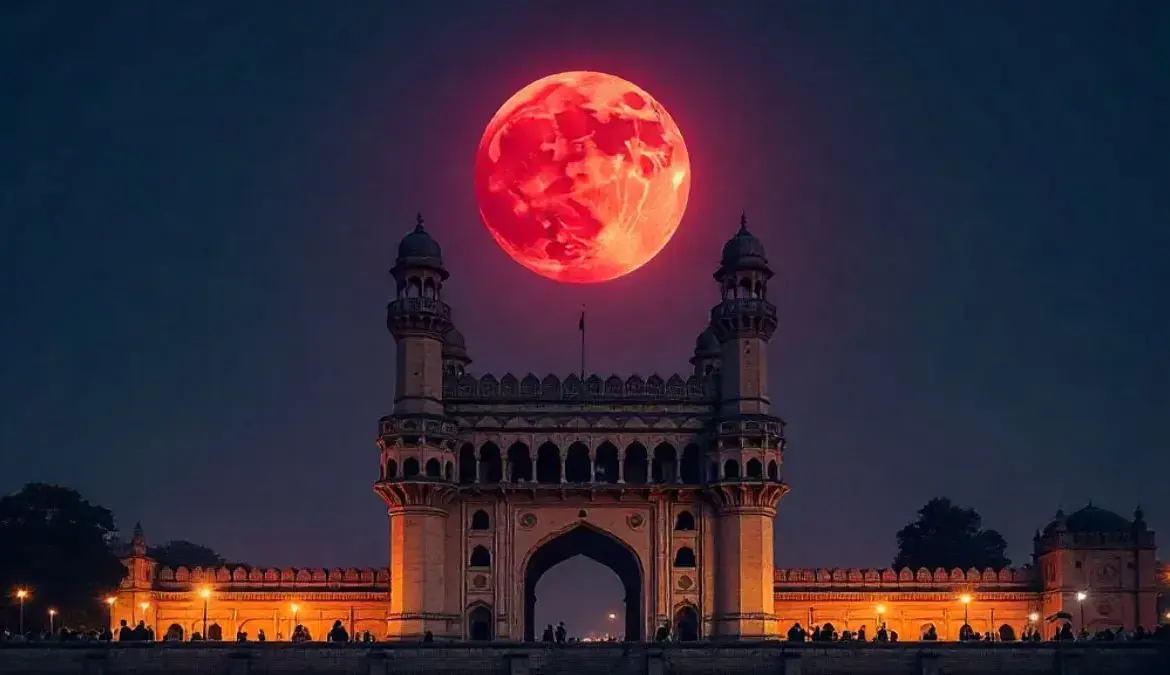
Grahanam timings today: Chandra Grahan on March 3, 2026
Understanding the Chandra Grahan
A lunar eclipse, or Chandra Grahan, occurs when Earth moves between the Sun and the Moon, casting its shadow on the Moon. This celestial event has long been a subject of fascination and reverence in various cultures, particularly in India, where it is often associated with significant rituals and observances. Prior to the upcoming eclipse on March 3, 2026, many enthusiasts and practitioners were keenly anticipating its timing and implications.
Key Timings for the Eclipse
On March 3, 2026, the Chandra Grahan will be observed across India, marking an important astronomical event. The Sutak Kaal, a period of preparation and abstention, will begin at 6:20 AM. Following this, the lunar eclipse will commence with the penumbral phase at 2:14 PM. The partial eclipse will start at 3:30 PM, leading into totality, which begins at 4:58 PM. The maximum eclipse, when the Moon will appear most dramatically affected, will occur at 5:25 PM, and totality will end shortly thereafter at 5:32 PM. The partial eclipse will conclude at 6:47 PM, with the penumbral phase ending at 7:53 PM.
Significance of the Event
This particular lunar eclipse is noteworthy not only for its timing but also because it coincides with the festival of Holi, a celebration of colors and joy in India. The overlap of these two significant events is expected to enhance public interest and participation in the eclipse viewing. Many people in the northeastern states of India will have the best vantage points to observe the eclipse, as these regions are predicted to experience the most dramatic views.
Expert Insights and Perspectives
Experts in astronomy emphasize the importance of such celestial events in fostering a greater understanding of our universe. The Chandra Grahan serves as a reminder of the intricate dance between the Earth, Moon, and Sun. Observing the eclipse can provide valuable educational opportunities, particularly for students and young enthusiasts. The event is also expected to draw attention to the cultural practices surrounding lunar eclipses, which often include rituals and observances aimed at harnessing the perceived energies of the eclipse.
Public Engagement and Observations
As the date approaches, various organizations and astronomy clubs are gearing up to host viewing events and educational sessions. These gatherings aim to provide safe viewing options and expert commentary on the eclipse phases. The excitement surrounding the Chandra Grahan is palpable, with many people planning to gather in groups to witness the event together, reinforcing community bonds through shared experiences.
Looking Ahead
The Chandra Grahan on March 3, 2026, is set to be a remarkable event, blending scientific interest with cultural significance. As the eclipse draws near, the anticipation continues to build, with many eager to witness the celestial spectacle. Details remain unconfirmed regarding specific local events and viewing arrangements, but the general public is encouraged to prepare for this extraordinary occasion.
With the Chandra Grahan fast approaching, the timings and events associated with this lunar eclipse are becoming clearer. As people across India prepare for this unique convergence of astronomy and culture, the excitement surrounding the grahanam timings today reflects a deep-rooted appreciation for the wonders of the universe.