Frohnmaier
Political Landscape Before the Shift
Before the recent developments, the Alternative for Germany (AfD) was seen as a minor player in Baden-Württemberg’s political arena. In the 2021 state election, the party garnered only 9.7% of the vote, making it the smallest faction in the parliament. This low standing was a significant setback for a party that had previously achieved a better result of 18.4% in a West German state election. The AfD’s image was marred by its classification as a right-wing extremist party by the state office for the protection of the constitution, which further complicated its acceptance among mainstream voters.
Decisive Changes in 2026
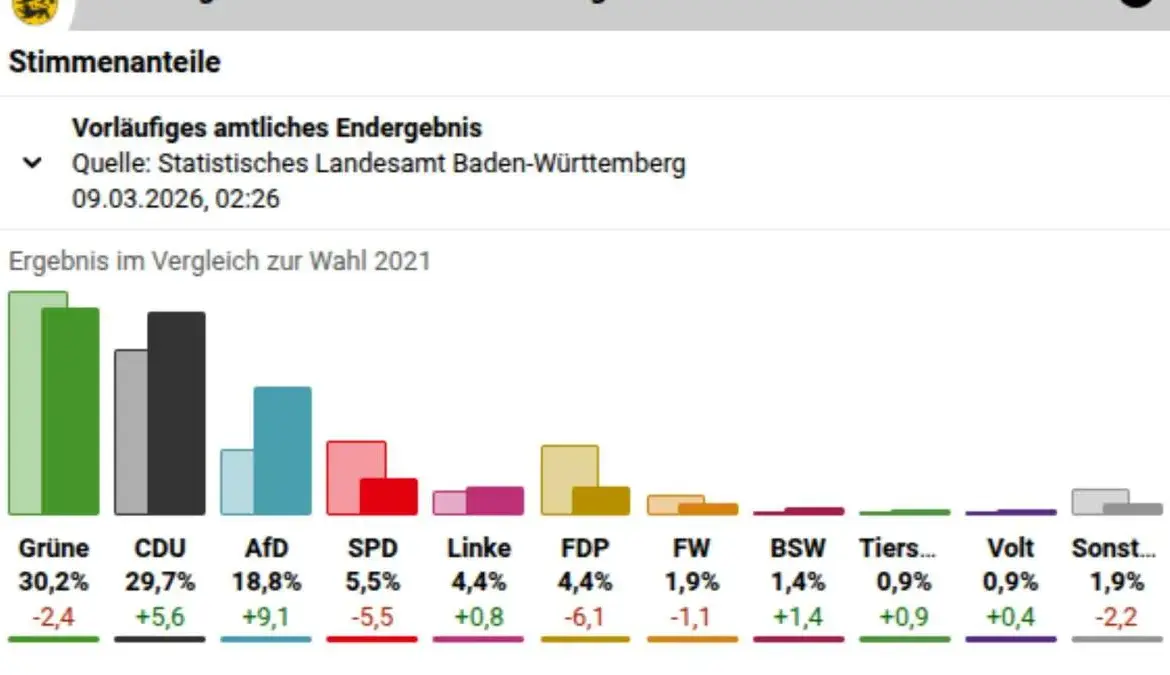
The political landscape shifted dramatically in the 2026 Baden-Württemberg state election, where the AfD achieved 18.8% of the vote, marking a remarkable 9.1% increase from the previous election. This surge positioned the AfD as the largest opposition party in the parliament, a significant leap that reflects changing voter sentiments. However, the party’s rise is not without controversy, particularly surrounding Markus Frohnmaier, who, despite being a Bundestag member and a candidate for Ministerpräsident, has been labeled a ‘fake candidate’ as he is not on the ballot for the election.
Impact on Key Players
Frohnmaier’s association with the AfD and his controversial background, including connections to Russia, have drawn attention. His close ties with AfD leader Alice Weidel and his attempts to position the AfD as a ‘bürgerlich-konservative Partei’ have sparked discussions about the party’s future direction. Frohnmaier’s offer of collaboration to CDU’s Manuel Hagel highlights a strategic move to broaden the party’s appeal, although Hagel’s rejection of any association with AfD votes underscores the ongoing resistance from traditional parties.
Expert Perspectives
Political analysts have noted that the AfD’s recent electoral success could be indicative of a broader shift in voter priorities, particularly among those disillusioned with mainstream parties. Alice Weidel expressed satisfaction with the election results, suggesting that they could lead to a doubling of the party’s previous performance. However, this optimism is tempered by the reality that many politicians, including Cem Özdemir, emphasize the need to counter the AfD’s influence, stating that their goal is to ensure the party is weaker in future elections.
Controversies and Challenges Ahead
Frohnmaier’s tenure has not been without challenges. His involvement in controversies regarding nepotism within the party and his controversial connections have raised questions about the integrity of the AfD’s leadership. As the party navigates its newfound status, it faces scrutiny not only from political opponents but also from within its ranks, as it seeks to solidify its position in the Baden-Württemberg parliament.
Looking Forward
As the AfD prepares for its role as the largest opposition party, the implications of Frohnmaier’s actions and the party’s overall strategy will be closely monitored. The dynamics of coalition-building and the potential for collaboration with other parties will be critical in shaping the future political landscape of Baden-Württemberg. With 7.7 million eligible voters in the state, the AfD’s ability to maintain its momentum will depend on how it addresses the controversies surrounding its leadership and the perceptions of its electorate.
The rise of Markus Frohnmaier and the AfD in Baden-Württemberg marks a significant shift in the region’s political dynamics. While the party’s increased electoral support reflects changing voter attitudes, the controversies and challenges it faces will play a crucial role in determining its future trajectory. As the political landscape evolves, the actions of key figures like Frohnmaier will be pivotal in shaping the discourse around the AfD and its place in German politics.