Argentina could face disciplinary action after World Cup final brawl and semi-final banner display
Post-Match Altercations and Disciplinary Actions
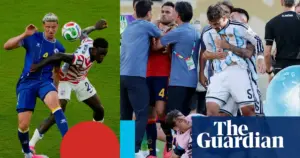
Argentina could face further disciplinary proceedings following a brawl at the conclusion of their World Cup final defeat against Spain. The incident saw Leandro Paredes sent off after clashing with Spain’s Eric Garcia and Gavi. Additionally, Nahuel Molina reportedly swung at Spain captain Rodri.
FIFA is set to investigate the post-match events to determine if additional disciplinary action is warranted. This process will be similar to the one initiated after Argentina’s semi-final victory over England.
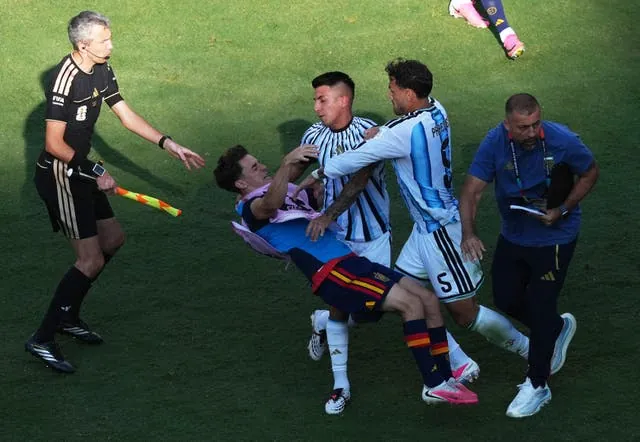
Paredes and Enzo Fernandez, who received a red card during normal time for two bookable offences, are each expected to receive a one-match ban for their red cards. This ban would apply to Argentina’s subsequent competitive match.
However, FIFA’s Disciplinary Code stipulates that players dismissed for violent conduct will be suspended for a minimum of three matches. Misconduct involving assault, such as elbowing, punching, kicking, biting, spitting, or hitting an opponent, carries a suspension of at least three matches or a suitable period of time. Sanctions can also be applied retrospectively.
Past instances of retrospective punishment in the World Cup include Luis Suarez receiving a nine-match international ban and a four-month ban from all football-related activities for biting Giorgio Chiellini in the 2014 World Cup group stages. Zinedine Zidane was also handed a three-match ban for headbutting Marco Materazzi in the 2006 World Cup final, though this ban was not enforced as he retired.
While the actions of Paredes and Molina in the 2026 World Cup final may not be as severe as these previous cases, FIFA has the discretion to extend the punishment beyond the standard three-match ban. Molina could also face a citation, as he did not receive a card from the referee during the match.
The Argentine Football Association (AFA) might also face disciplinary action if FIFA’s investigation uncovers further instances of misconduct. FIFA’s code allows for disciplinary measures against a national association if its team behaves improperly, such as when five or more players receive individual disciplinary sanctions during a match.
More broadly, Argentina’s conduct after the final whistle could be viewed as bringing the sport and/or FIFA into disrepute, potentially leading to additional disciplinary measures.
Incidents Leading to Criticism
The post-match brawl began when Spain’s Mikel Oyarzabal and Rodri ran past Molina after the final whistle, following Spain’s victory. Molina reportedly swung at Rodri, causing the Spain captain to stop and confront the Argentina defender. Molina then bumped Rodri in the chest, which prompted Garcia to intervene.
Paredes, who had already been booked during the final, then charged towards Garcia, knocking him to the ground. After Garcia stood up, Paredes jabbed him in the throat. Argentina coach Lionel Scaloni approached, attempting to break up the scuffles. As Scaloni separated Garcia and other Argentina coaching staff became involved, Paredes turned his attention to Spain’s midfielder Gavi.
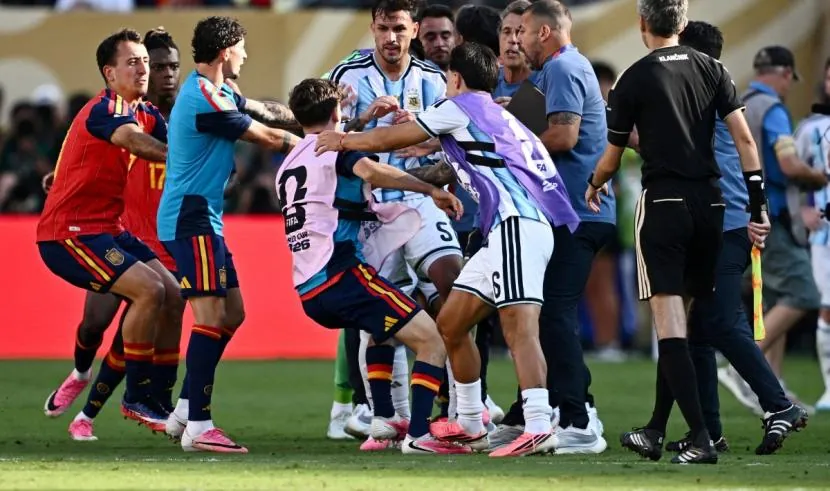
Paredes spun Gavi to the ground and appeared to push into his face while holding him by the bib. Several of Gavi’s Spanish teammates then intervened to shield him, with Spain’s Borja Iglesias colliding with Paredes. Video footage also seemed to show Argentina assistant coach Daniel Ayala striking Spain midfielder Dani Olmo.
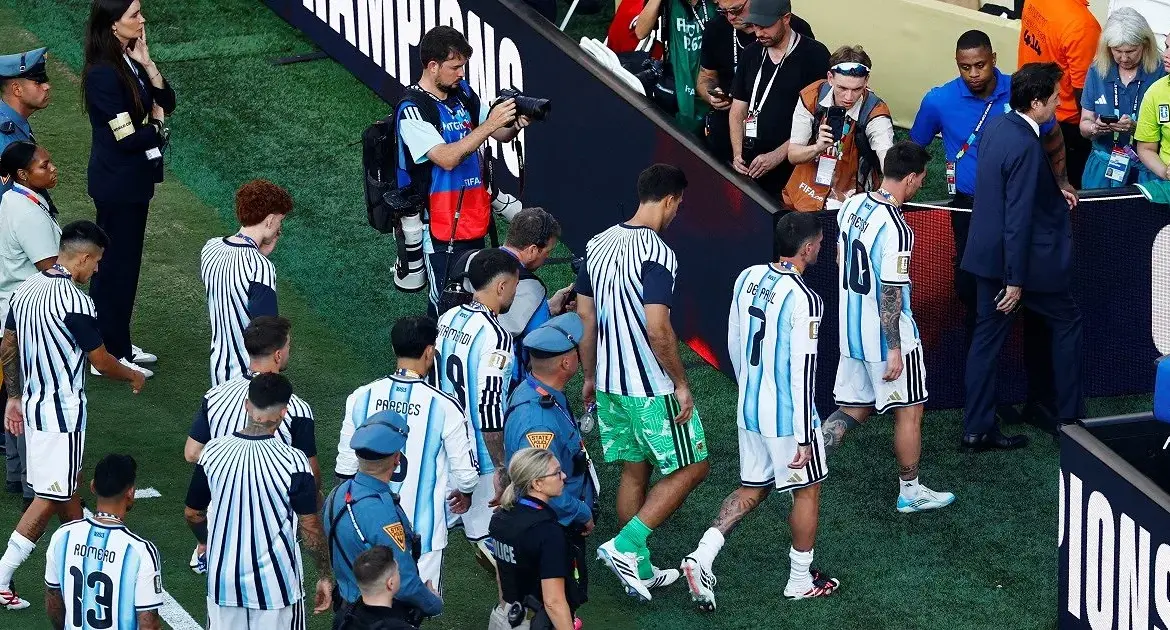
Beyond the physical altercations, Argentina’s conduct during the medal ceremony also drew criticism. After collecting their silver medals, Argentina’s players did not remain to applaud the newly crowned champions. Instead, Lionel Messi and his teammates walked to the far side of the pitch as Spain prepared to lift the World Cup trophy, declining to form a guard of honour.
The atmosphere intensified when Spain midfielder Rodri was presented with the Golden Ball award for the tournament’s best player. Argentina supporters in the stadium chanted Messi’s name during the presentation.
Semi-Final Controversy and Prior Sanctions
Disciplinary action could also stem from Argentina’s semi-final win against England. After defeating England, several Argentina players displayed a banner that read, “Las Malvinas son Argentinas,” which translates to “The Falkland Islands are Argentinian.”
A FIFA spokesperson stated after the semi-final that FIFA’s independent Disciplinary Committee was assessing match reports and relevant circumstances to decide on potential further steps based on the FIFA Disciplinary Code. Downing Street had called for an investigation into Argentina’s celebrations following their 2-1 victory over England.
The AFA was previously fined £20,000 by FIFA in 2014 after Argentina’s players displayed a banner with the same message. Two years prior, Rodri and Spain teammate Alvaro Morata received one-match bans for chanting “Gibraltar es Espanol” after their Euro 2024 final victory over England, following a complaint from the Gibraltar Football Association.
Read Also
Source: independent.co.uk