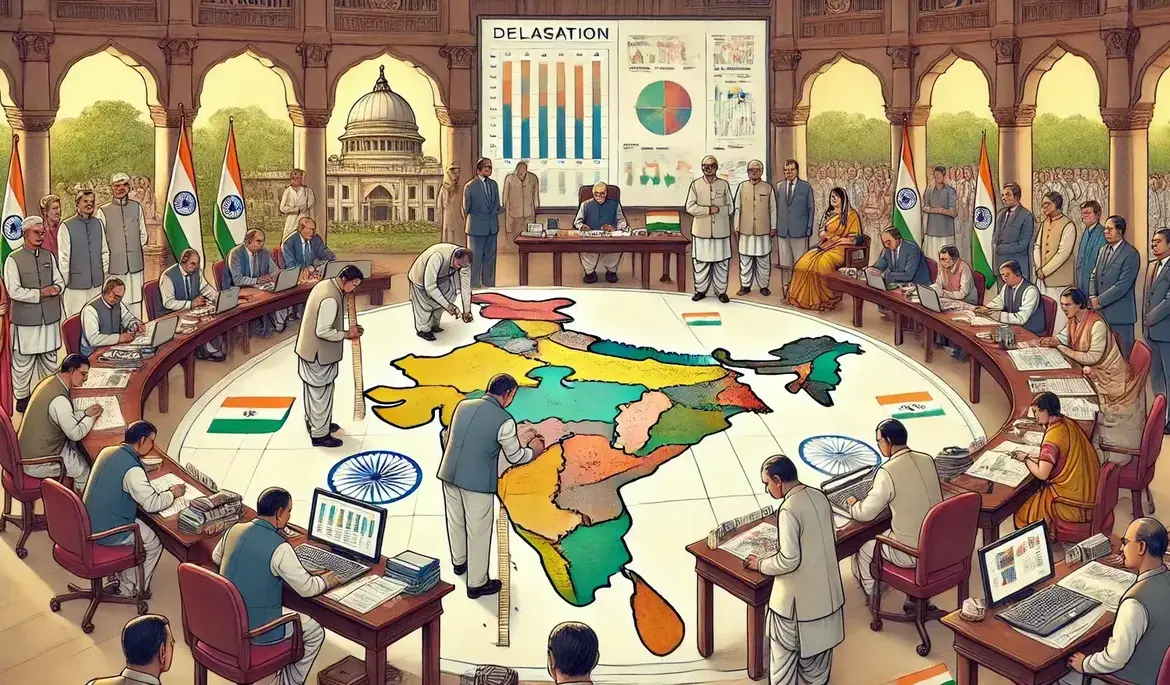
Delimitation: A New Era for the Lok Sabha
As the political landscape of India continues to evolve, a significant development is on the horizon. On April 14, 2026, the Union Government announced a proposal to increase the strength of the Lok Sabha from its current 543 members to a remarkable 850 members. This proposal is part of a broader initiative to amend the Constitution and reshape the representation within the Parliament.
The proposed amendment seeks to delete the requirement that delimitation must follow the post-2026 Census, a move that has sparked discussions among political analysts and citizens alike. The Bill, which will be discussed during the Special Session of Parliament on April 16 and 17, aims to amend Article 82 of the Constitution, allowing for a more flexible approach to constituency boundaries.
One of the key aspects of this Bill is the establishment of a Delimitation Commission, which will be empowered to redraw constituency lines. This Commission will be chaired by a person who is or has been a Judge of the Supreme Court, ensuring that the process is conducted with integrity and impartiality. The Bill also proposes to amend Article 81, which would allow for a maximum of 815 members from the states and 35 from Union Territories, thus broadening the representation across the nation.
In a historic move towards gender equality, the Bill includes a provision for 33% reservation for women in the Lok Sabha and State Assemblies. This is a significant step forward in promoting women’s participation in politics, addressing a long-standing issue of underrepresentation in legislative bodies.
Currently, the composition of the Lok Sabha is based on the 1971 Census, and the existing allocation of seats has been frozen since the 84th Amendment Act of 2001, which stipulated that constituency boundaries would remain unchanged until the first census after 2026. With the latest published census being in 2011 and the next expected to conclude in 2027, this proposed amendment could pave the way for a more representative and responsive Parliament.
As the government prepares to bring forth a Constitution amendment Bill, a Bill on delimitation law, and an enabling bill for its application in Delhi, Jammu and Kashmir, and Puducherry, the implications of these changes are profound. The Bill states that orders issued by the Delimitation Commission, once published in the Gazette of India, will have the force of law and cannot be challenged in any court, ensuring a streamlined and efficient process.
This sequence of events matters significantly for the citizens of India. With a larger Lok Sabha and enhanced representation for women, the government aims to create a more inclusive and equitable political environment. As discussions unfold in Parliament, the outcomes of these proposals will undoubtedly shape the future of Indian democracy.