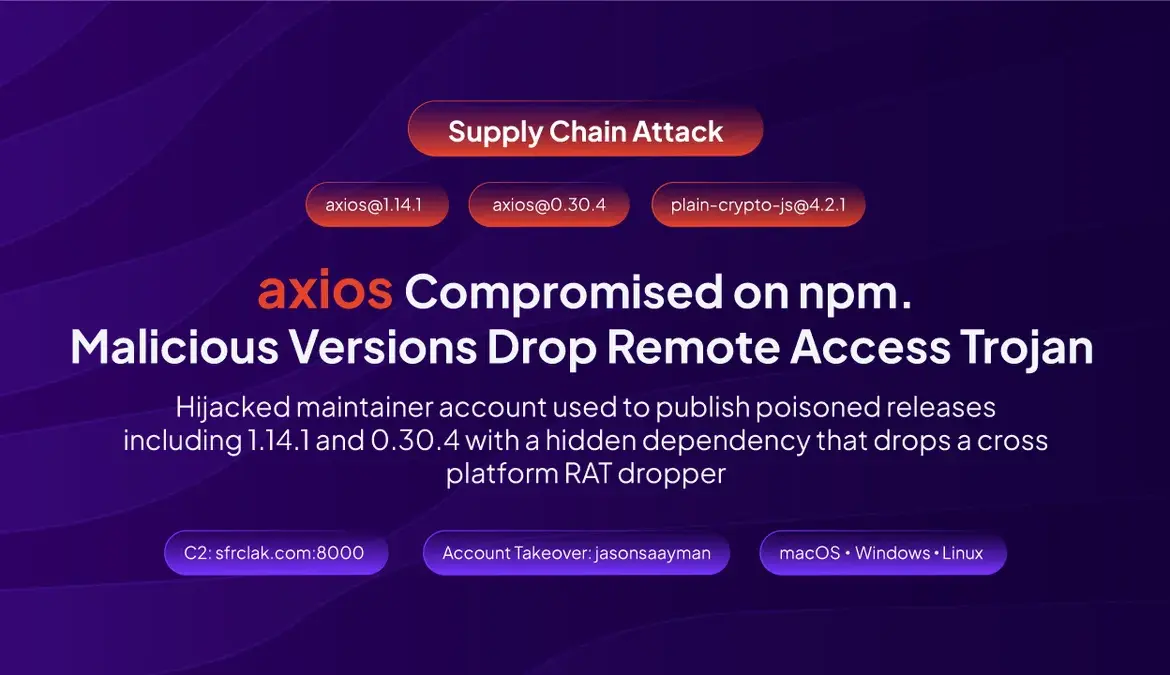
Axios Faces Supply Chain Attack Amidst Popularity
Key moments
In a startling development, two malicious versions of the widely used JavaScript library axios were published on the npm platform on March 31, 2026. The versions, v1.14.1 and v0.30.4, were live for approximately 2 hours and 53 minutes and 2 hours and 15 minutes, respectively, before being removed shortly after their discovery. This incident has sent ripples through the developer community, raising alarms about the security of software supply chains.
The malicious versions were uploaded using compromised credentials belonging to a lead maintainer of axios, a library that boasts over 100 million weekly downloads and is utilized in approximately 80% of cloud and code environments. The attack was pre-staged for roughly 18 hours before the malicious packages went live, indicating a high level of planning and sophistication.
As part of the attack, a malicious package named [email protected] was injected as a dependency, designed to evade detection by appearing legitimate. This package included a cross-platform Remote Access Trojan (RAT) that targeted macOS, Windows, and Linux systems. The RAT dropper executed a postinstall script that connected to a command-and-control server, potentially compromising the systems of unsuspecting users.
Detection of the malicious activity was made possible by the StepSecurity AI Package Analyst and the StepSecurity Harden-Runner, which identified the anomalous behavior of the connection. It was noted that the connection was automatically marked as suspicious because it had never appeared in any prior workflow run. This highlights the importance of robust monitoring tools in safeguarding software environments.
Despite the severity of the attack, it was reported that execution of the malicious code was observed in only 3% of affected environments. This statistic suggests that while the attack was sophisticated, the actual impact may have been limited. However, organizations are strongly advised to audit their environments for any potential execution of the compromised versions to ensure their systems remain secure.
Experts have emphasized that there are zero lines of malicious code within axios itself, which underscores the danger of this attack. The fact that a trusted library was exploited through compromised maintainer credentials demonstrates the vulnerabilities that can exist even in widely used software. As the community processes this incident, it serves as a reminder of the critical need for vigilance in software security.
In response to the attack, the axios community and security experts are rallying to enhance security measures and prevent future incidents. The swift removal of the malicious packages from npm reflects a proactive approach to mitigating risks. However, the incident has sparked discussions about the need for better credential management and monitoring practices within open-source projects.
As the dust settles, the axios team and the broader developer community are left to reflect on the implications of this attack. With the increasing reliance on open-source software, ensuring the integrity and security of these resources is more crucial than ever. The community’s response and the lessons learned from this incident will shape the future of software development and security practices.