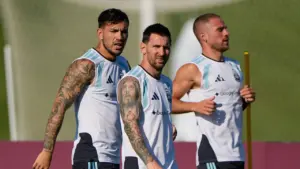
Bellingham’s brace sends England to World Cup semifinals after Norway clash
England advances to semifinals
England secured a spot in the World Cup semifinals after a 2-1 victory over Norway in Miami. The match saw Jude Bellingham score both goals for England, including a crucial equaliser in the first half and the winning goal in extra time. This win places England among the final four teams, joining Argentina, France, and Spain.
The quarter-final fixture was marked by a controversial moment involving Bellingham’s first goal, which generated debate regarding a potential camera cable deflection. However, FIFA later clarified the incident, confirming the goal was legitimate.
Controversy over Bellingham’s equaliser
The initial debate surrounding Bellingham’s first-half equaliser stemmed from television footage that suggested the ball might have struck an overhead Spidercam cable. This apparent contact, some viewers believed, altered the ball’s trajectory before it reached Harry Kane, leading to the attack that resulted in Bellingham’s goal.
Norway’s players and manager, Ståle Solbakken, expressed frustration, with Erling Haaland seen gesturing towards the referee. Under International Football Association Board (IFAB) Laws of the Game, if the ball hits an overhead fixture, play must be stopped immediately, and restarted with a dropped ball.
Former FIFA referee Mark Clattenburg, an officiating analyst, noted that VAR could intervene if such contact was part of an attacking phase leading to a goal. The central question was whether the ball indeed touched the cable.
FIFA’s clarification and connected ball technology
Following the match, FIFA addressed the controversy by releasing data from its connected ball technology. This system, embedded in each official match ball, continuously records movement and physical contact, generating a ‘heartbeat’ spike for every touch.
FIFA’s statement confirmed that no such spike was recorded when Nyland’s goal kick passed beneath the overhead camera system. The governing body also provided data from its Snicko-style tracking system, which similarly showed no detectable contact. This evidence led FIFA to conclude that the ball did not touch the overhead wire, and Bellingham’s equaliser was correctly allowed to stand.
Despite the controversy, England progressed. Norway had initially taken the lead in the 36th minute through Andreas Schjelderup. Bellingham’s equaliser came in the 45+2nd minute. Norway thought they had regained the lead in the second half, but Torbjørn Heggem’s goal was disallowed by VAR due to a foul by Erling Haaland earlier in the move. Bellingham secured England’s victory in extra time, reacting quickly after Morgan Rogers’ shot was saved by Nyland.
Team selection and tactical concerns
Amidst the victory, there were discussions regarding Thomas Tuchel’s team selection and tactical decisions. Concerns were raised about the omission of Kobbie Mainoo from the lineup, despite his potential as an option off the bench. The midfield saw various changes throughout the match, with Declan Rice, Anderson, Eberechi Eze, Reece James, and Morgan Rogers all featuring in central roles.
Some observers noted that the team appeared to have lost its spark, and the coach’s best XI seemed uncertain. Bellingham’s performance was highlighted as exceptional, seemingly carrying the team through a challenging encounter. The match in Miami’s heat proved to be a demanding one for England, but Bellingham’s efforts ultimately secured their advancement to the semifinals.
The 2026 World Cup semifinals will feature the top four ranked teams in the world for the first time since FIFA rankings began in 1992.
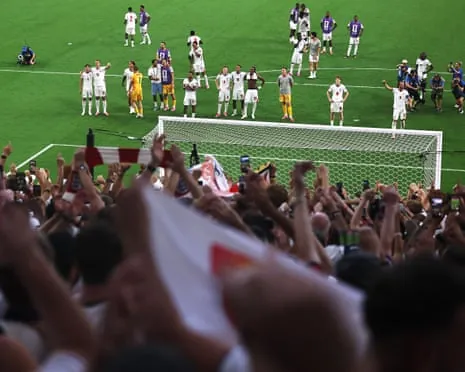
Argentina also advanced to the semifinals after requiring extra time to overcome European opposition, with Julian Alvarez being a key player in their victory.
Read Also
Source: theguardian.com